
The Hours That Belong to Us
The right to rest grew from a simple question: how much of a person's life should work be allowed to claim?
Imagine a worker reaching home while there is still light in the sky. A child wants to show him something beside the river. There is bread to cut, a neighbour to speak to, perhaps nothing in particular to do. For once, the evening is not merely the short distance between one working day and the next. There is enough of it left to inhabit. That small freedom has a history.
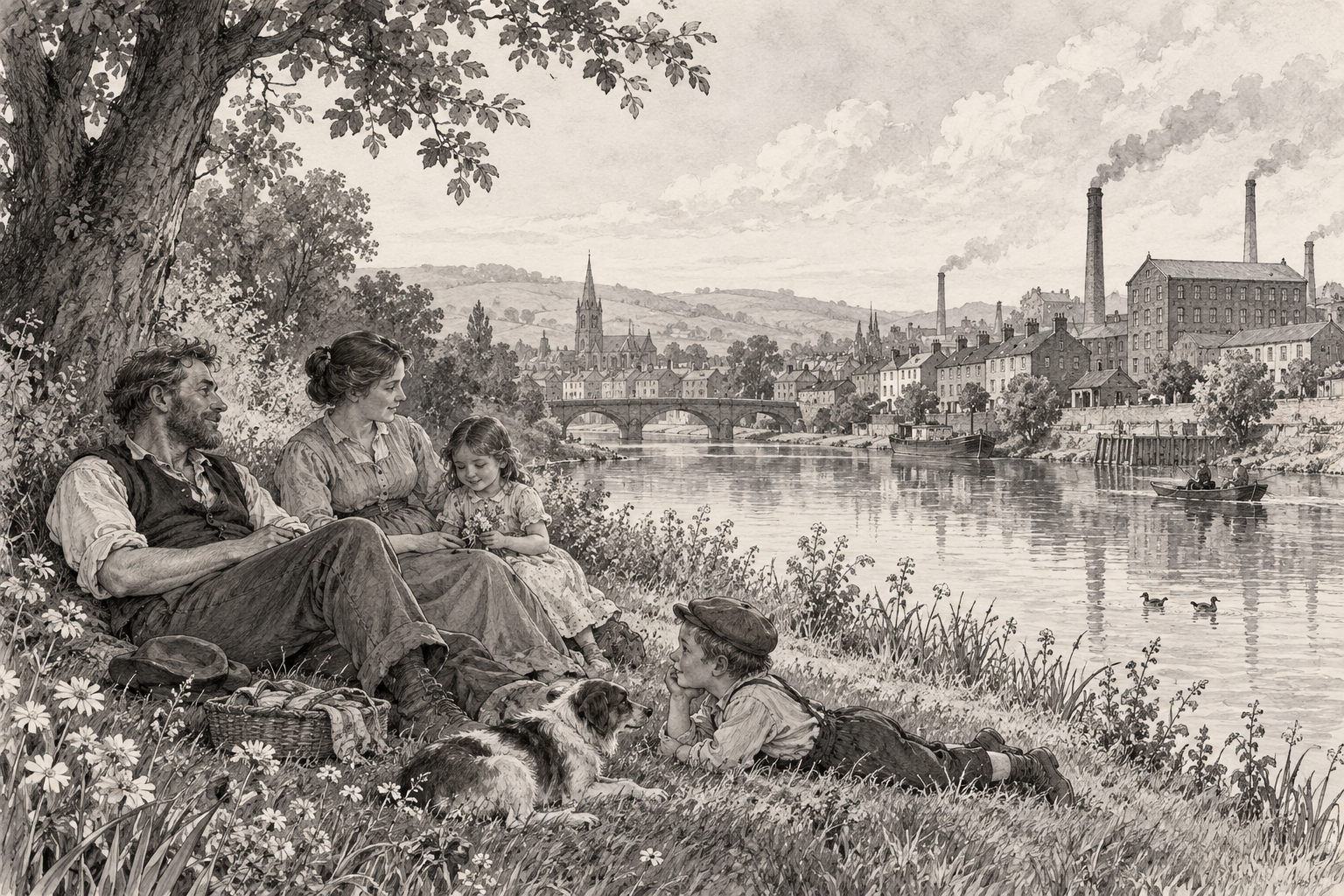
We often describe time away from work as though it were the space left over when the serious business is finished. Yet the struggle over working hours asked a much larger question. Does earning a living entitle someone else to organise almost the whole of your waking life? A limit on the working day places a boundary around an employer's claim. Beyond it, the person should have other possibilities.
Rest itself was no modern invention. Religious observance, seasonal rhythms and local customs had long provided different forms of interruption. But a custom could be uneven, and a welcome pause could depend on circumstances beyond the worker's control. The modern argument for protected time made a further demand: people should be able to count on it. Rest needed a place in the arrangements governing work, rather than remaining an occasional kindness.
The campaign for an eight-hour day was already established before the International Labour Organization was founded in 1919. Its first convention set an eight-hour day and a forty-eight-hour week as the general standard for industrial work, with specified exceptions. It did not instantly give every worker those hours. Its importance lies partly in making the length of the working day a subject of international agreement, rather than something to be settled only by whoever held the stronger bargaining position. [1]
In 1921, another ILO convention addressed weekly rest in industry. Its general requirement was at least twenty-four consecutive hours of rest in each seven-day period, again with qualifications and exceptions. The distinction matters. A person can work fewer hours overall and still find those hours arranged so that no proper stretch of life remains available. Time scattered in small pieces does not always offer the freedom of an uninterrupted day. [2]
By 1948, Article 24 of the Universal Declaration of Human Rights included rest and leisure, reasonable limits on working hours, and periodic paid holidays. Here was a striking statement about the kind of creature a human being is. A person needs more than the opportunity to keep producing. The reference to pay also recognised a practical difficulty: permission to stop is a thin gift when stopping means being unable to meet the rent. [3]
There is an easy way to defend rest that leaves me slightly uneasy. We say it makes people more productive afterwards. Often it may. But if that becomes the whole argument, the evening beside the river must eventually justify itself at the factory gate. The child, the conversation and the quiet walk become useful because they return a better worker to the employer. Their value as parts of a life slips out of view.
I would rather leave room for an afternoon that produces nothing reportable. Someone might mend a jacket slowly, watch a bird from a window, or sit with a friend whose company needs no occasion. These things need not be impressive to deserve protection. A society reveals something about its priorities when ordinary people can enjoy them without first proving exhaustion or exceptional achievement.
There is also a question about whose rest is being made possible. One person's free evening may depend on another person cooking, cleaning or caring without a break. A day away from paid employment is not automatically a day free from labour. Any generous account of leisure must look inside the home as well as beyond the workplace, and ask how the necessary tasks are shared.
Nor can every service stop at the same hour. People still need transport, care and help when others are asleep. That makes fair arrangements more important. The difficulty of organising rest should prompt thought about staffing, rotation and responsibility. It should not quietly become an argument that some people's time matters less because their work is needed more.
What moves me in this history is the insistence that an ordinary life deserves room. The worker coming home before dark is not necessarily preparing for something greater. Perhaps he will simply walk down to the water and listen to his child. There may be no record of what they say. The hours are valuable because they are theirs, and because a life should contain moments that do not have to answer to anyone else.