Law
Justice Needs an Audience That Can Follow the Plot
Opening the courtroom door is only the beginning. Public scrutiny depends on making the proceedings intelligible.
Original essays, literary criticism, and illustrated reflections on society and everyday life.
Featured essay · History of Ideas
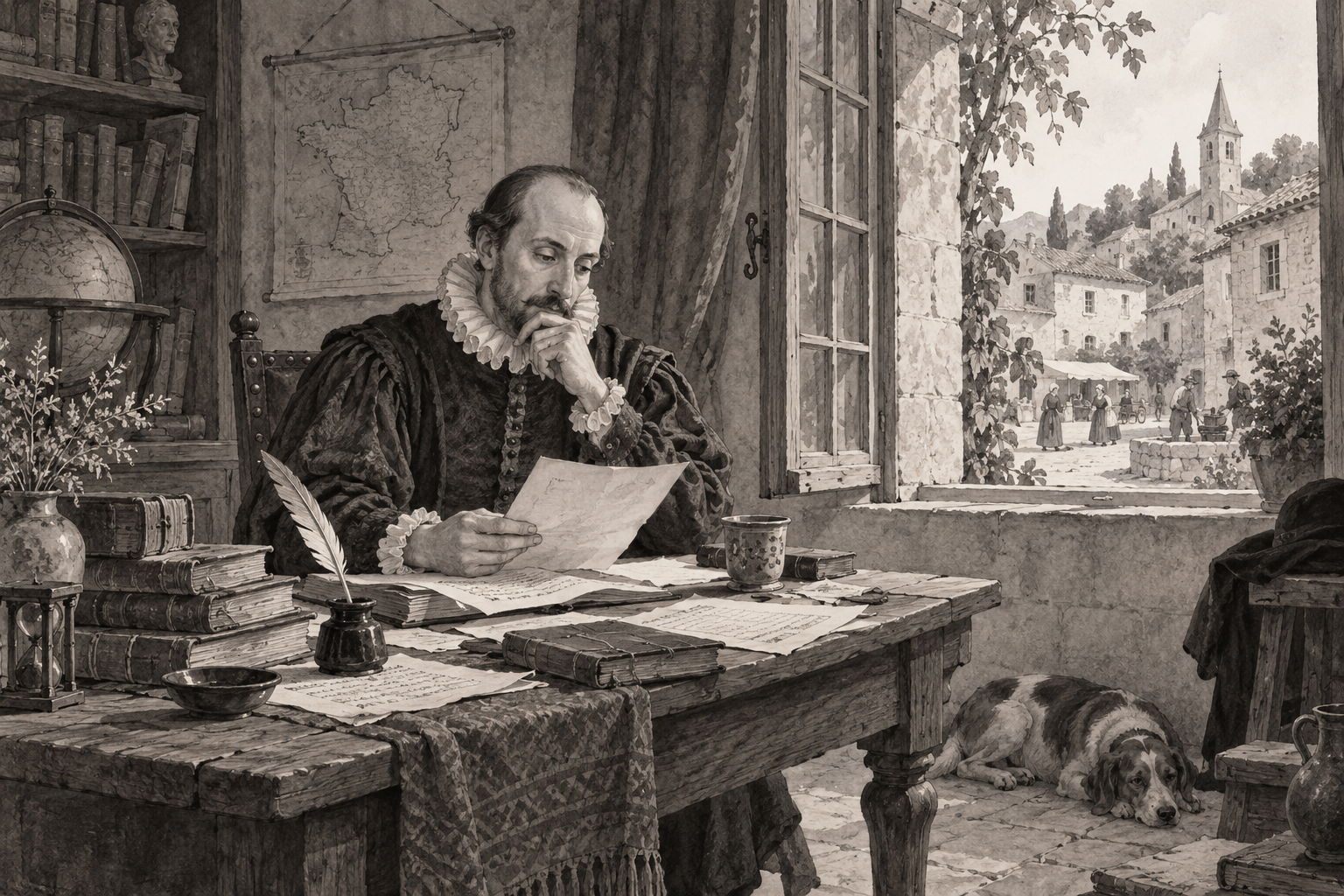
Montaigne, Bacon and the quiet courage of leaving room for another answer.
Read the essayLaw
Opening the courtroom door is only the beginning. Public scrutiny depends on making the proceedings intelligible.
Literature
Austen's least accommodating heroine exposes the danger of treating gratitude as a promise of obedience.
History of Ideas
The public museum made a generous promise. The difficulty was deciding who could actually walk through its doors.
One thoughtful email each week: an illustrated essay, a reading recommendation and a question worth considering.
Five ways into The Paragraph: ideas, books and the questions within ordinary life.
History of Ideas
Begin with a question: how can a confident mind remain willing to change?
History of Ideas
Rousseau, Froebel and the argument for taking childhood seriously.
Law & society
Explore the distance between having a right to speak and being able to use it.
Books & criticism
Return to Mary Shelley through questions of creation, responsibility and belonging.
Everyday life
Find a quieter starting point in an ordinary moment of attention.
Drawings and short reflections on the things we almost overlook.
New: The Saved Seat, The Borrowed Ladder, The Repaired Cup, The Unread Book, The Held Door.

The bag had enjoyed a longer welcome than most strangers.
Explore The Other Side, Ordinary Ethics and three more recurring series. Follow the Who Gets Heard? reading path, or send a letter to the editor.
Essays and short notes on the arrangements that shape a life.
Original pieces on law, economics, fairness, responsibility, technology, and everyday life.
Inflation, debt, housing, inequality, trade, AI and work, climate finance, ageing, food security, and the global monetary order.
Read the complete ten-essay collection
Book summaries, from The Odyssey to One Hundred Years of Solitude, with authors, themes, personal critiques, and reading notes.
Fifteen complete essays on truth, friendship, power, learning, and the art of living. Each has a reading note; the ten latest additions also include an editor’s critique.
Explore the Technology collection
A coffee can be ordered without speaking. A journey can be planned without asking. A quiet moment can be filled before we have noticed it was quiet.
Each convenience makes sense on its own. Together, they raise a question: how many of our encounters with other people began as small inconveniences?
Perhaps loneliness is one reason technology becomes irresistible. A screen asks so little of us when the world outside it feels difficult to approach.
Explore the Society & fairness collection
We often describe fairness as an open door. But reaching that door takes time, money, confidence, and sometimes help from somebody who already knows the way.
A society can make the same offer to everyone while leaving people with very different means of accepting it. Thinking seriously about opportunity means paying attention to those differences.
Essays on access to justice, constitutional power, fairness, medical decisions, and responsibility.
Original essays based on official archived opinions, from judicial review to presidential accountability.
An organisation that asks people to take risks for the truth must be willing to bear some of the cost.
A promise to listen matters most when listening becomes uncomfortable. The test comes when a concern challenges somebody with power, or when acting on it would disrupt the familiar way of doing things.
How much confidence should we place in a principle whose consequences are carried entirely by the person who follows it?
We imagine a milestone as a place where the uncertainty will stop. Graduation, a new job, a move: each can seem to promise a settled version of ourselves.
Then we arrive, and ordinary life continues. There is another morning, another decision, another thing we do not yet understand. The achievement is real. So is the beginning that follows it.
New editorial reflections to accompany the classic essays.
Bacon asks why falsehood can appeal even when it brings no obvious advantage. His answer makes truth a question of appetite as well as evidence: we may prefer the account that flatters us. Read alongside the site's notes on institutions, the essay invites a further question. What happens when a group becomes attached to a reassuring story about itself, and who is permitted to interrupt it?
Bacon treats reading, conversation, and writing as different forms of intellectual work. Knowledge must meet experience before it becomes judgement. That distinction matters in a world where collecting information is effortless. A useful test after reading is to put the source aside, explain the argument in your own words, and name one experience that might challenge it.
Bacon separates the wish to repair a wrong from the wish to make somebody suffer. His essay leaves a difficult question for the reader: what should a person do when the available institutions provide no remedy? The text is worth reading critically, especially where its praise of forgiveness meets the practical need for accountability.
Stevenson's defence of idleness is a defence of curiosity, conversation, and learning outside recognised occupations. His idler pays attention to the life that ambitious people hurry past. The argument also has a limit: leisure is easier to celebrate when survival does not depend on constant work. Reading the essay today means holding both its insight and that inequality in view.
Stevenson describes achievement as an opening onto further desires. A finished project can bring satisfaction and an unexpected emptiness; the purpose that organised the days has disappeared. His essay offers a companion to The Trouble with Arriving: perhaps a good ambition is one that makes the journey worth living, even when the destination changes.
Bacon begins with a reversal: the person who commands others may have very little command of his own life. His essay moves from the private costs of office to the public obligations that might justify them.
Friendship offers Bacon emotional relief, clearer judgment, and practical help. Beneath his examples of princes and favourites lies a more intimate observation: we often discover what we think by trying to tell someone we trust.
Bacon asks what great wealth can actually do for its owner. His answer distinguishes enjoyment from custody, display, and distribution, before turning to the ways money is acquired and passed on.
Bacon distinguishes the wish to achieve important things from the wish to be important in everything. His essay is also a revealing manual for rulers who want the energy of ambitious people while fearing their independence.
Bacon argues that repeated practice governs conduct more reliably than declarations of principle. Education, companionship, and institutional example can strengthen that force, for good ends or bad ones.
Stevenson disputes the assumption that a disappointed older person necessarily understands life better than an enthusiastic younger one. He treats changing opinions as stages of experience rather than automatic evidence of earlier foolishness.
Stevenson’s answer to mortality is a defence of active engagement with life. His most moving claim concerns unfinished work: an undertaking can matter even when its maker will never see it completed.
Stevenson examines the objects, performances, and invented rules through which children inhabit their games. He ends by questioning the adult habit of demanding exact factual accounts from minds so absorbed in make-believe.
For Stevenson, a walking tour changes the traveller’s relation to time. Solitude, bodily rhythm, and an unhurried evening loosen the habits that make every hour answerable to a task.
Stevenson welcomes the spectacle of a city illuminated at once, yet recoils from the harshness of particular electric lights. His defence of gaslight asks what technological improvement feels like at street level.
How ideas about time, freedom, childhood, sympathy and progress came to shape ordinary life.
How measured hours became a claim on working lives—and why a useful clock need not become a judge of every moment.
Privacy developed through arguments about property, personality and publicity; its value reaches beyond having something to hide.
The history of schooling asks who was allowed to learn—and whether access meant an equal chance to imagine a different life.
Gifts, obligations and markets have long overlapped. Their history challenges the assumption that a price tells us everything about value.
The defence of dissent grew through arguments about truth and authority, but its hardest test remains the voice we would rather not hear.
The public library grew from a generous idea: you should not have to buy a book, or prove your usefulness, before being allowed to read.
The right to rest grew from a simple question: how much of a person's life should work be allowed to claim?
Montaigne and Bacon approached knowledge differently, but both help us see why a confident mind still needs the habit of questioning itself.
Adam Smith's account of sympathy asks how another person's life can become important to us, even when we have nothing to gain.
From Rousseau's defence of childhood to Froebel's kindergarten, a quiet educational argument changed what adults were prepared to take seriously.
Condorcet's belief in human improvement still shapes our hopes, but progress becomes a better idea when it is treated as a responsibility rather than a promise.
A publication for curious readers, bringing together essays, literary criticism, and reflections on the ways we live together. Read about The Paragraph and its editorial approach.
Editorial notes express the editor’s perspective. Republished essays are credited to their original authors; reading notes are separate editorial commentary.