A Room Where You Owe Nothing
The public library grew from a generous idea: you should not have to buy a book, or prove your usefulness, before being allowed to read.
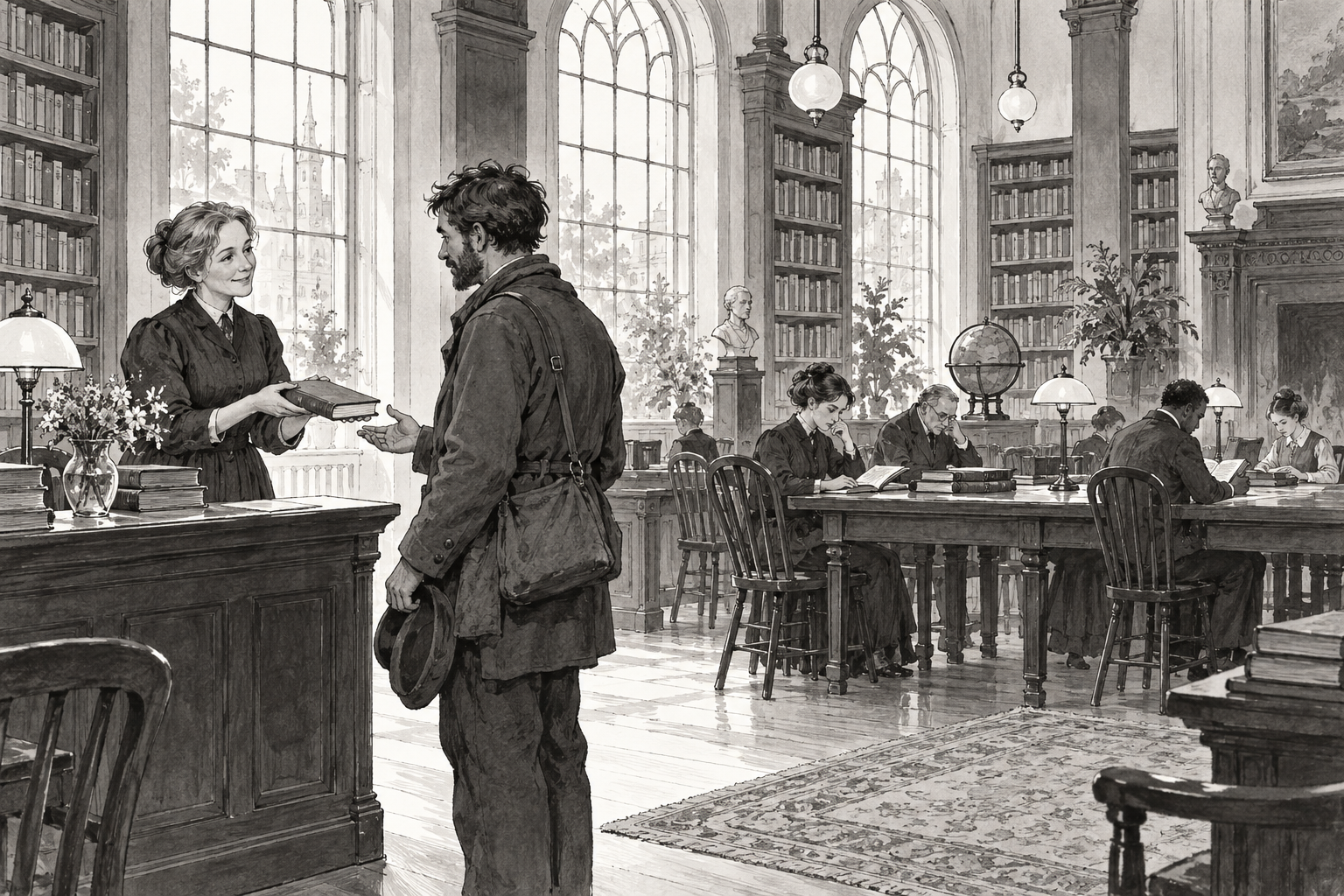
Picture someone coming in from the rain. They shake the water from their coat, find a chair and open a book they could not afford to buy. Nobody brings a menu. Nobody asks whether they are waiting for a paying customer. For a while, their wish to read is enough. It is an ordinary library scene, but the welcome it describes rests on a remarkable public choice.
Libraries are much older than the modern public library. What changed in nineteenth-century Britain was the growing willingness to support free local provision through public funds. The Public Libraries Act of 1850 allowed municipal boroughs in England and Wales to establish libraries under certain conditions. It did not require every town to open one, and early restrictions on funding limited what could be achieved. [1]
One restriction is especially striking. The original permitted levy could support buildings and staffing, but could not be used to buy books. Later legislation widened the powers available. This small detail captures the distance between accepting an idea and giving it enough support to work. A room may be approved long before the means of filling it have been agreed. [1]
In the Commons debate of February 1850, William Ewart argued for removing admission charges to the proposed libraries and museums. Even a small payment, he suggested, was an obstacle. The question was not simply whether knowledge existed somewhere. It was whether a person could reach it without meeting a charge at the door. Access required a practical decision about who would pay. [2]
That decision did not make the library cost nothing. Books must be chosen, buildings maintained and staff paid. Free entry means that the bill is carried together rather than presented to each reader on arrival. We understand this distinction easily enough with a streetlight. Its light is not free to produce, but we do not usually ask pedestrians to pay before standing beneath it.
The library adds something less easy to measure. It gives people room to follow an interest before they know what that interest will become. Someone may arrive looking for a repair manual and leave with a book about the sea. A child may read the same story repeatedly. A retired person may begin learning a language with no examination ahead. None needs to promise an economic return.
There were limits to the welcome offered by earlier libraries. Historic England describes arrangements that controlled access to books and separated readers by class, sex or age. The institution's ideals developed unevenly. Remembering this prevents us from mistaking an attractive old reading room for proof that everyone within it was treated equally. A public building can still contain private assumptions about who belongs. [1]
The idea continues to ask something of us. The 2022 IFLA–UNESCO Public Library Manifesto presents libraries as places supporting education, culture, inclusion and access to information. That is an ambition to be put into practice, not a guarantee supplied by the name above the entrance. A welcome needs suitable hours, helpful staff and a way of asking questions without feeling foolish. [3]
What I value most is the permission to arrive without a finished purpose. So many invitations ask us to describe what we want, what we can spend or what we expect to achieve. A good library allows a quieter beginning: I am interested, but I do not yet know enough to explain why. There is dignity in having that uncertainty taken seriously.
The title is not quite literal. Readers owe care to the books and consideration to one another. But they should not owe a purchase, a performance of gratitude or evidence that their curiosity will prove profitable. The person drying their coat has already brought what matters: a mind that may find something here. Keeping a chair available for that possibility is a modest, lasting act of hope.