The Child Who Was Allowed to Play
From Rousseau's defence of childhood to Froebel's kindergarten, a quiet educational argument changed what adults were prepared to take seriously.
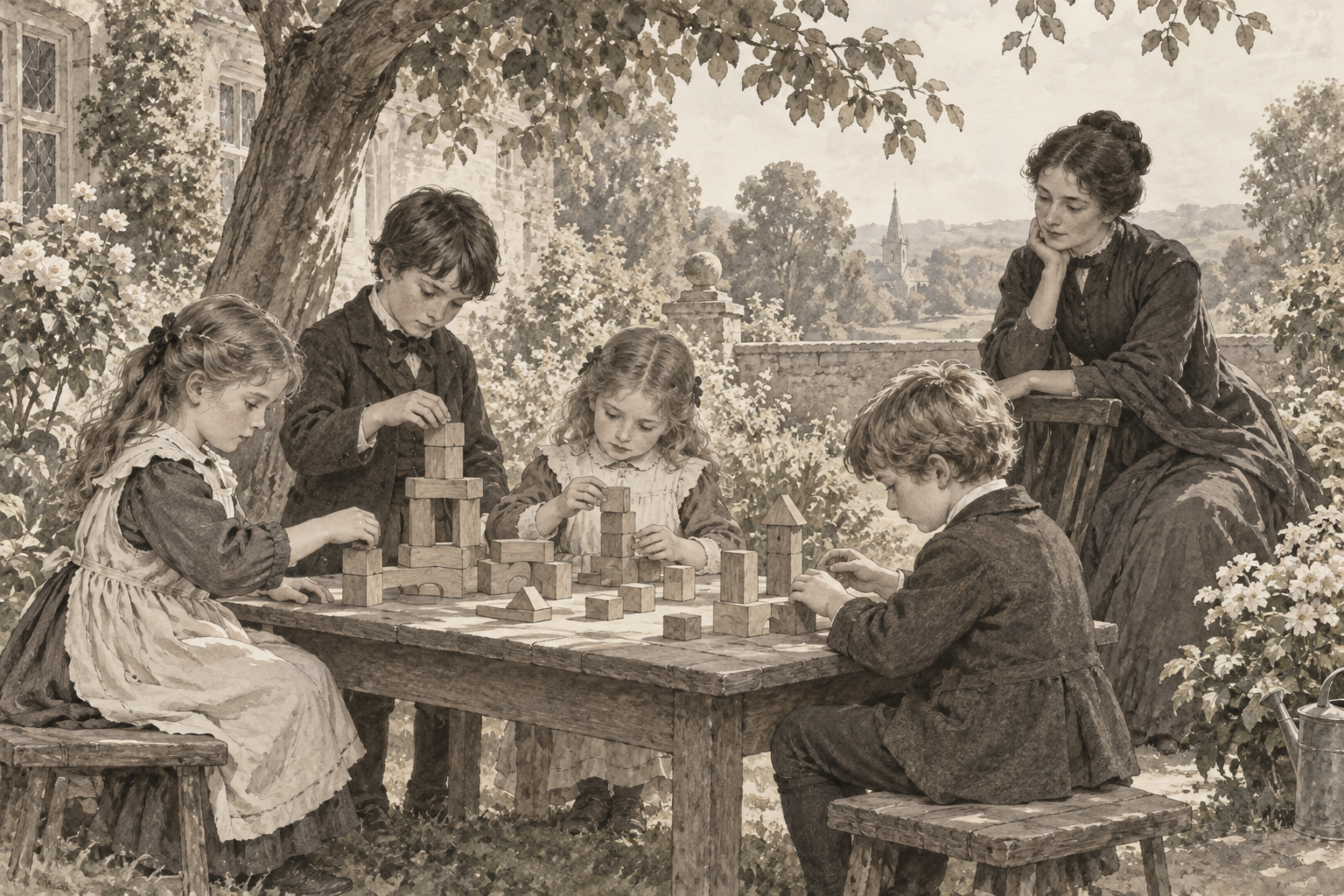
A child is building a bridge from wooden blocks. The first attempt collapses. The second is too narrow for the small cart waiting beside it. An adult could solve both problems quickly, perhaps with an explanation about balance. Instead, she watches while the child moves one block, pauses, and tries again. Nothing about this scene appears revolutionary. Yet the decision to let it continue contains an idea that educational thinkers had to defend: childhood has work of its own, and it does not always resemble an adult's lesson.
Adults have understandable reasons for looking ahead. Children need skills, habits and knowledge that will help them live with others. The difficulty begins when the future claims every hour of the present. A question becomes valuable because it might improve a result. A game becomes acceptable because it can be described as training. The child is treated as someone under construction, with little attention paid to the person already here.
In Emile, published in 1762, Jean-Jacques Rousseau challenged education that sacrificed a child's present happiness to an uncertain future. His imagined pupil was to encounter the world through experience, with learning suited to his development. Childhood deserved its own place in life. Rousseau asked adults to take children's pleasures and ways of understanding seriously, rather than continually measuring them against the person they would eventually become. [1]
This was no complete discovery of childhood, and it would be unfair to suggest that earlier families had been incapable of affection or delight. Nor should Rousseau become a flawless champion. His tutor carefully arranges much of the freedom offered to Emile, while Book V assigns Sophie an education centred on a restrictive account of women's role. The book contains both a challenge to adult domination and striking examples of its persistence. [1]
That tension is useful. Educational freedom is difficult to offer because adults remain responsible for what happens. We select the room, the materials, the time available and the risks that seem acceptable. The question is therefore not whether adults can disappear from the process. It is whether their presence helps a child develop purposes of their own, or quietly replaces those purposes with a plan the child is merely invited to obey.
In nineteenth-century Germany, Friedrich Froebel gave play a central place in his kindergarten approach. The materials he developed, known as Gifts, included balls and sets of wooden shapes and blocks. These offered children things to handle, combine and explore. A cube could become part of a building, a pattern, or an experiment whose interest was not obvious to the adult watching. The Froebel Trust describes their use in German kindergartens in the 1840s. [2]
The simplicity of the materials is part of their appeal. A toy that supplies every sound, story and outcome leaves less for a child to decide. An ordinary block can accept several meanings because it does not insist on one. Today the Froebel Trust presents the tradition through principles that include children's own activity, relationships, nature and adult guidance that enriches play. Childhood is valued in itself, alongside its importance for later learning. [3]
Consider the bridge again. Its collapse may involve disappointment, an argument about whose turn comes next, or a sudden decision to build a house instead. An adult looking only for the planned result might see wasted time. A more patient observer can notice the questions taking shape. What will hold? Why did that work yesterday? Can we make something together when we disagree about what it should be?
There is no need to romanticise every moment. Play can exclude, frighten or frustrate. Children may need help entering a group, sharing materials or recovering from a quarrel. Leaving them entirely alone is not the same as respecting them. A thoughtful adult notices when a small intervention will open a possibility and when an unnecessary instruction will close one. Such judgement demands attention; it is not an easier version of teaching.
It also requires conditions that families and educators cannot produce by goodwill alone. Room to move, suitable materials and an adult with time to listen are not equally available. A crowded home or an overstretched classroom can turn a generous ideal into another demand placed on people already doing their best. If we value children's freedom, we must care about the practical circumstances that make it possible.
There is a temptation to defend play by listing its future returns. It may support capacities we rightly value. But I would hesitate to make those returns its entire justification. We do not ask every adult conversation to demonstrate an improvement in earning power. Children should have some experiences whose worth lies in being absorbed, amused or curious now. Their present life deserves more than a promise that it will eventually prove useful.
The history of this idea remains unfinished because the pressure to hurry childhood never quite disappears. It can arrive as affection, anxiety or ambition. A parent wants to give a child every chance and fills the afternoon accordingly. A school wants evidence of progress and begins to prefer activities that leave a measurable trace. Everyone may mean well, while the space for an unplanned discovery gradually shrinks.
The bridge finally stands, though it may not be the bridge the adult would have built. The child sends the cart across and calls someone over to see. There will be time for instructions, practice and harder tasks. For now, a problem has become an interest, and the interest has been allowed to last. To take that seriously is to recognise a person whose life has already begun.