The Future We Learned to Expect
Condorcet's belief in human improvement still shapes our hopes, but progress becomes a better idea when it is treated as a responsibility rather than a promise.
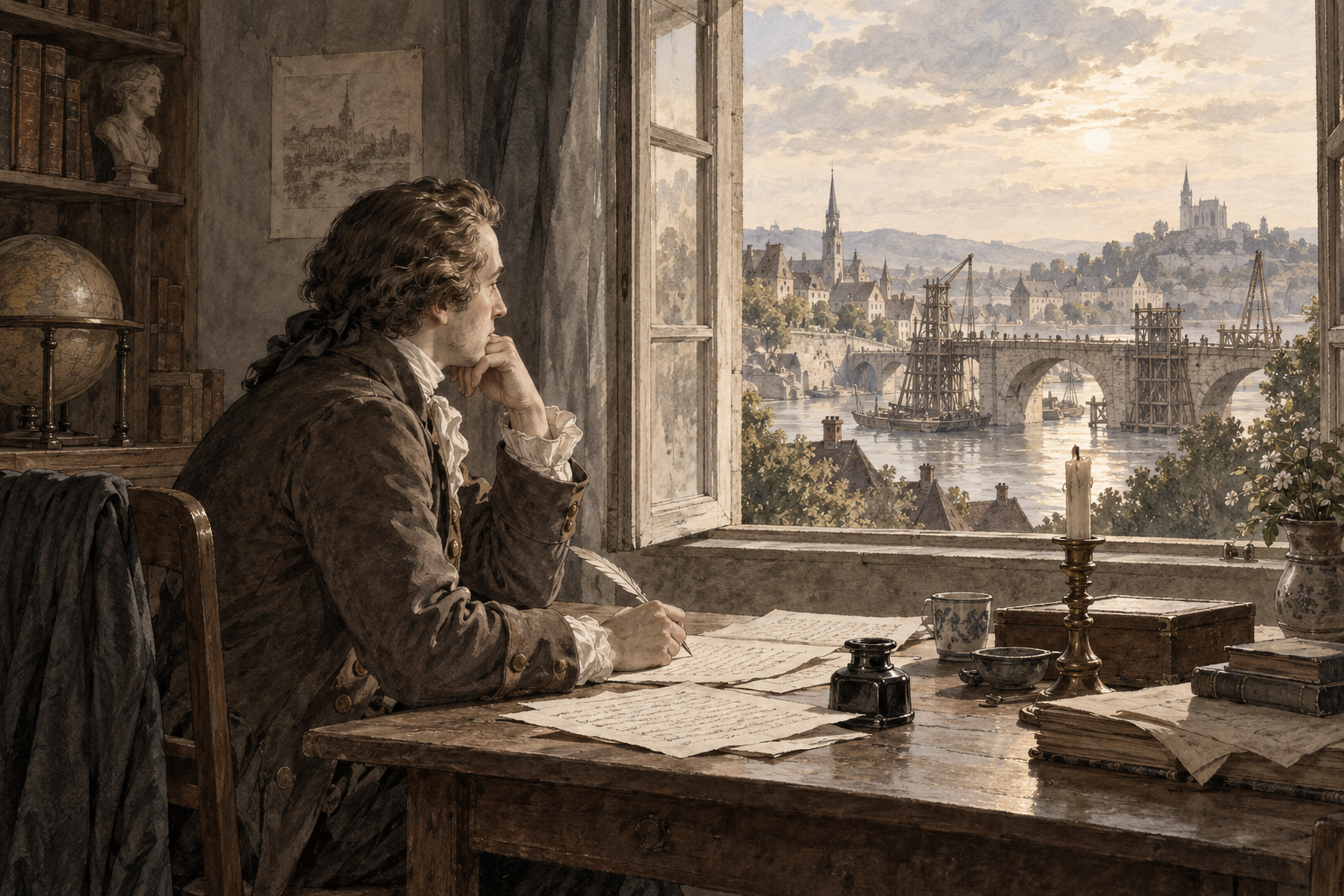
Imagine opening an old drawer and finding a drawing of a town that was never built. There are broad streets, a school, a bridge across the river and generous space between the houses. Someone once looked at this sheet and saw a better life waiting to happen. Perhaps parts of the plan were realised. Perhaps the money ran out, or the people who already lived there objected. The drawing preserves something more than an abandoned scheme. It preserves the belief that tomorrow could be deliberately made better than today.
That belief feels familiar enough to pass unnoticed. We expect improvements from a new treatment, a new government or a new way of working. Yet change and improvement are different claims. A machine can become faster while the person operating it has less control over the day. A town can become wealthier while some of its residents can no longer remain there. The future arrives automatically. A better future requires more explanation.
One influential version of that explanation appeared in Condorcet's Sketch for a Historical Picture of the Progress of the Human Mind, published after his death in 1795. In its final section, he looked towards reduced inequality between nations, greater equality within them, and improvement in human capacities. Accumulated knowledge could help people understand their circumstances and direct their lives. History, in this account, offered grounds for hope about what people might yet achieve. [1]
It is easy to dismiss such confidence after learning how much suffering later generations endured. But hope about improvement can perform valuable work. If poverty or exclusion is regarded as simply the natural order, there is little reason to examine the arrangements that sustain it. The belief that circumstances can change gives criticism somewhere to go. A complaint may become a question about what should be built, taught, repaired or organised differently.
Condorcet's vision also carried a serious limitation. He treated European and Anglo-American societies as models towards which others should advance, describing other peoples through a hierarchy of civilisation. His opposition to inequality did not free his account from these assumptions. A history that arranges societies along one ladder gives those who imagine themselves near its top considerable power to define everyone else's destination. [1]
We can recognise the problem without abandoning every hope of improvement. The more useful response is to become precise. Improvement in what? Greater safety, a wider choice of work, more reliable food, less humiliation when asking for help? These aims can be discussed and contested. The word progress becomes less persuasive when it is allowed to stand alone, as though any objection to a particular scheme were an objection to the future itself.
There was disagreement within the eighteenth century too. In his Discourse on the Sciences and Arts of 1750, Rousseau questioned whether cultivated manners and achievements in learning had made people morally better. Refinement could decorate dependence and conceal dishonesty. His argument challenges the comfortable assumption that intellectual accomplishment, social polish and decent conduct must advance together. We need not accept his whole judgement to recognise the question it leaves behind. [2]
A familiar example might be a service moved entirely online. The new arrangement could save time for many people, make information easier to find and reduce repetitive work. Those are real gains. It might also leave someone unable to explain an unusual problem, especially if every route ends in the same automated response. Calling the system modern does not settle the experience of the person trying to use it.
The proper comparison would look at both sides. Who benefits, who struggles, and what help exists when the standard route fails? Could the new convenience be kept while preserving a way to reach a person? Such questions make improvement a practical undertaking. They require us to describe the human result we want, rather than admire the novelty of the means used to pursue it.
Another difficulty appears when benefits lie in the future and costs are paid now. A neighbourhood may be asked to endure years of disruption for a promised renewal. Workers may be told that insecurity is the unavoidable price of change. Sometimes transitions do involve genuine costs. But people carrying those costs deserve evidence, a voice in the decision and a fair share of the eventual benefit. A distant promise should not make a present objection inaudible.
At the same time, scepticism can become too comfortable. Someone who already enjoys safety and opportunity may find it easy to praise restraint when others are asking for improvements they badly need. There is nothing wise about preserving a preventable hardship simply because every reform contains uncertainty. Caution should improve a proposal by testing it. It should not excuse us from making one.
What I would keep from the idea of progress is the refusal to treat unnecessary suffering as permanent. What I would set aside is the expectation that time, knowledge or invention will settle our moral choices for us. Better tools enlarge what we can do. They do not decide whose needs deserve attention or how much inconvenience the powerful should accept for the benefit of somebody else.
Return to the drawing in the drawer. The bridge may still be worth building. The school may be needed more than ever. But the people who would use them should be able to question the plan, change its priorities and insist that its promises reach their lives. Hope survives such scrutiny. It becomes more believable when those expected to live inside the future have a hand in drawing it.