When Time Became Money
How measured hours became a claim on working lives—and why a useful clock need not become a judge of every moment.
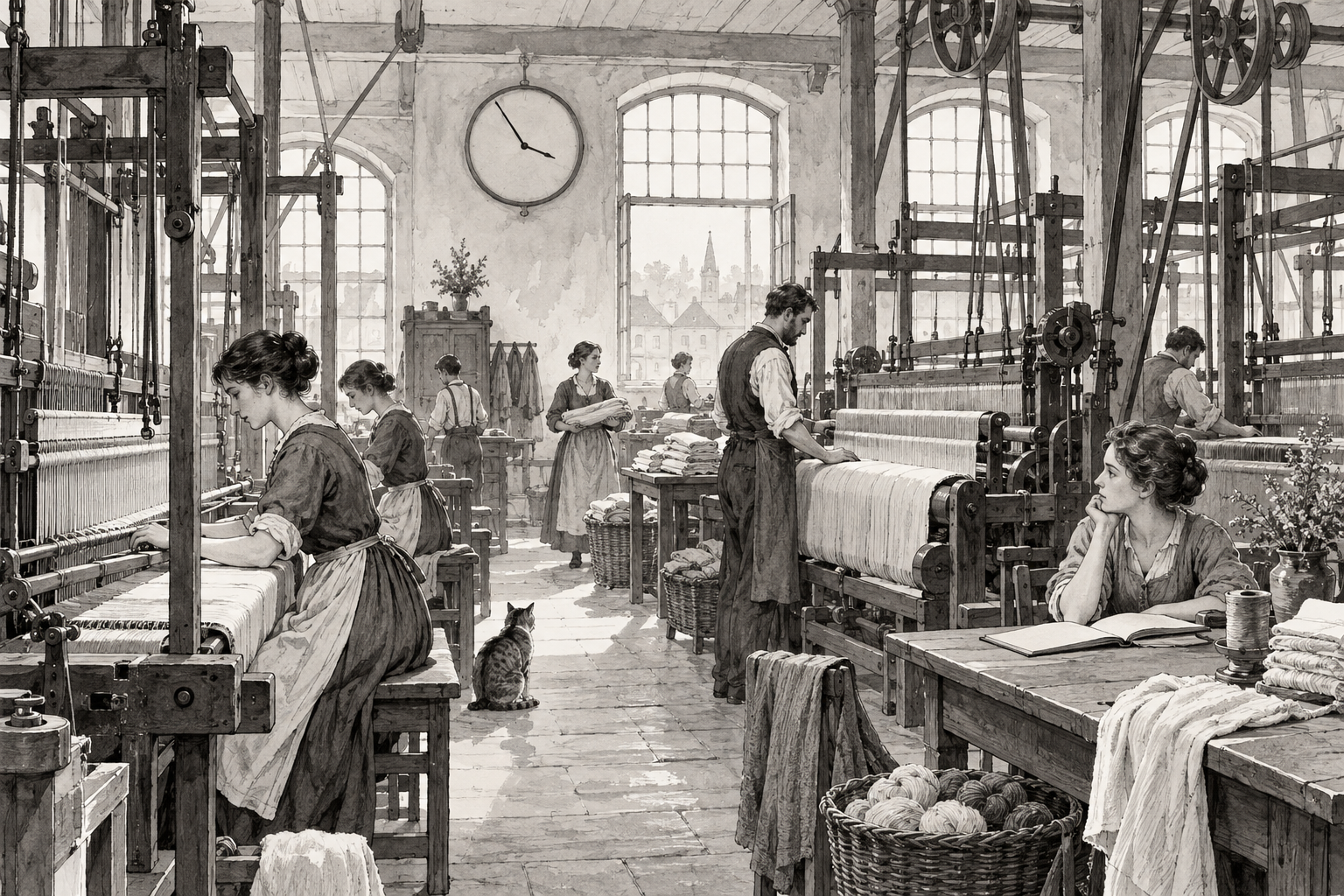
A clock above a workshop can appear to be the least political object in the room. It points, ticks and agrees with itself. Yet the moment its hands determine when somebody may arrive, eat or leave, it becomes part of an arrangement between people. The mechanism measures duration. The arrangement decides whose purposes that duration must serve. Confusing those two functions makes authority look like a property of time itself.
In his 1748 Advice to a Young Tradesman, Benjamin Franklin urged his reader to remember that time was money. His calculation included income forgone during an idle afternoon, not merely the coins spent enjoying it. The argument was addressed to someone trying to maintain a livelihood and credit. It was practical advice, but it also supplied a way of looking at leisure: an unearned sum could be imagined beside an otherwise inexpensive pleasure. [1]
Franklin did not invent paid labour or punctuality. In his influential 1967 essay, historian E. P. Thompson examined the uneven movement from work organised around tasks towards increasingly rigorous clock discipline in industrial Britain. Employers sought dependable hours; workers resisted, negotiated and eventually used measured time to press claims of their own. This was a contested historical change, not a single invention that instantly reorganised every household. [2]
That qualification matters. Earlier work could be exhausting, insecure and governed by powerful masters. The absence of a factory clock did not make a person free. Harvests, weather and domestic obligations could impose demands more relentless than a timetable. The historical contrast is useful when it reveals different forms of control, but misleading when it turns an imagined rural afternoon into evidence that everybody once lived at a gentler pace.
Consider the difference between completing a repair and remaining available until a shift ends. The first arrangement concentrates attention on a finished task. The second gives somebody a claim on an interval, including the moments when there is temporarily nothing useful to do. Neither arrangement is always fairer. Payment by the task can reward speed while concealing preparation; payment by the hour can protect careful work while encouraging the performance of constant busyness.
Measured time can therefore support a worker's freedom. An agreed finishing hour establishes a boundary that an endlessly expandable duty may lack. Overtime becomes visible only when ordinary time has a limit. The same clock that supervises an arrival can document a late departure. What matters is who can invoke its authority, whose records are believed and whether an agreed boundary remains meaningful when the work becomes inconvenient.
Outside employment, the calculation grows stranger. A conversation with a friend can be treated as an investment in a relationship. Reading becomes an exercise in acquiring useful knowledge. Even rest is defended as preparation for greater productivity tomorrow. These descriptions sometimes illuminate a benefit, but they can also make an activity sound permissible only when it serves something beyond itself. An afternoon begins to resemble an application for funding.
My own objection is to that widening jurisdiction. I value dependable appointments and dislike having my time wasted. But I do not want the pleasure of a walk to depend on the number of steps recorded, or the worth of a book to depend on what it improves. We need ways to protect our hours without requiring every protected hour to produce a result.
The clock is an extraordinary instrument of coordination. Its usefulness does not establish a complete philosophy of living. We can insist that working time be honestly counted while leaving some experiences unpriced. Perhaps the most valuable hour is sometimes the one in which nobody asks us to explain what it was for.