The Courage to Say Perhaps
Montaigne and Bacon approached knowledge differently, but both help us see why a confident mind still needs the habit of questioning itself.
Someone tells a story at dinner. It is a good story, neatly shaped, with a foolish person at its centre and a lesson everyone recognises. You are about to agree when a small question occurs to you. How do we know that is what happened? Asking may interrupt the pleasure of the evening. Saying nothing is easier. The history of doubt begins, in part, with learning to take that small hesitation seriously.
Doubt has an unfortunate reputation. It can sound timid, evasive or faintly disloyal. We admire people who know their own minds, and there is good reason to value decisiveness. Yet knowing your mind is not quite the same as knowing whether it has understood the matter correctly. A conviction can feel settled because it has been tested. It can also feel settled because nothing has been allowed to disturb it.
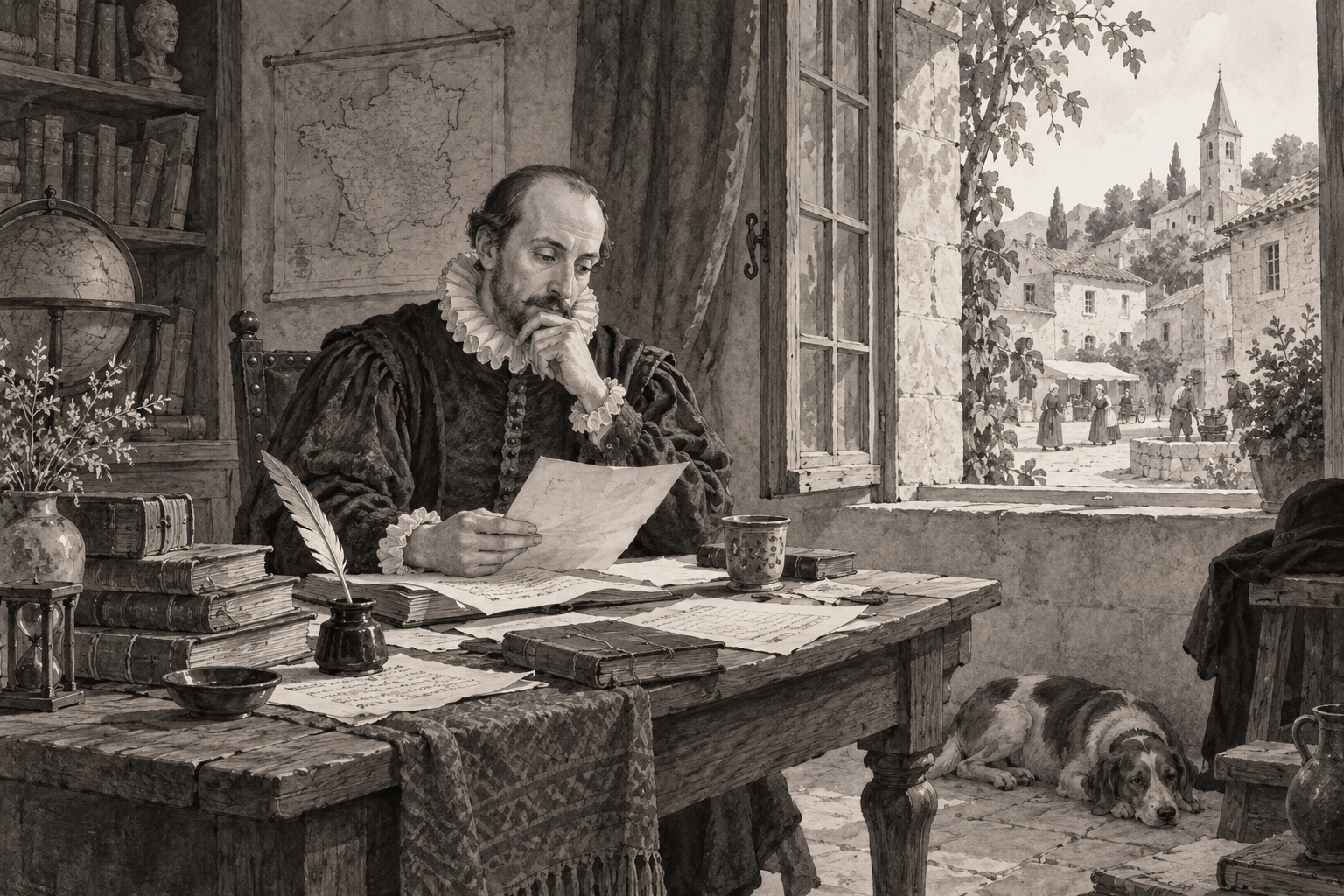
In his sixteenth-century Essays, Michel de Montaigne repeatedly examined the instability of human judgement. In the chapter on custom, he considered how familiar practices acquire authority over us. In the chapter on the uncertainty of judgement, he explored how circumstances can upset apparently sensible conclusions. His writing allows a thought to be tried, complicated and reconsidered in front of the reader. The mind on the page remains a mind at work. [1]
That is part of the continuing pleasure of reading him. He gives uncertainty a human voice. The person thinking is affected by habit, experience and limitation; he does not float above the world delivering verdicts. This need not mean surrendering all judgement. It means remembering that the instrument with which we judge is also something worth examining.
A little later, Francis Bacon approached the difficulty through a programme for investigating nature. In Novum Organum, published in 1620, he described recurring obstacles to understanding as different kinds of idols. Human tendencies, individual habits, misleading words and inherited systems could all distort inquiry. He also observed how readily people favour evidence that supports an opinion they have already accepted. Greater confidence alone would not repair these faults. Inquiry needed discipline. [2]
Montaigne and Bacon should not be squeezed into one tidy doctrine. Their projects and methods differed. But reading them together suggests a useful pair of questions. What in me makes this explanation attractive? And what in the world would help establish whether it is true? The first question checks our vanity. The second prevents self-examination from becoming an endless conversation with ourselves.
Consider a familiar workplace judgement. A colleague misses a deadline, and we decide that they are careless. Perhaps they are. Yet there may have been unclear instructions, conflicting demands or a difficulty nobody noticed. Doubt does not require us to invent an excuse. It asks us to distinguish the event we observed from the character we have constructed around it. That distinction can change the next question we ask.
It also changes how we listen. If I am entirely certain that I have understood your motives, your explanation becomes an obstacle to my account of you. I hear it mainly to find its weakness. If I allow that I may have missed something, the same words become possible information. The conversation has somewhere to go. Neither of us needs to win immediately for it to be worthwhile.
Of course, doubt can be misused. Someone can demand another investigation whenever the evidence becomes inconvenient, or insist that nothing is ever known well enough to justify action. That is a way of protecting a conclusion through endless delay. Useful doubt accepts that evidence can answer a question. It asks for reasons, gives them appropriate weight, and remains willing to act when the balance is sufficiently clear.
The practical challenge is therefore to give uncertainty a proper size. A minor choice may need only a moment's thought. A serious accusation deserves closer examination. We cannot investigate every belief from the beginning each morning. We can, however, become more alert when our certainty arrives unusually quickly, especially when the conclusion flatters us or makes someone we dislike appear worse.
What I value most is the possibility of correction without disgrace. If changing a view is treated as humiliation, people acquire a reason to defend mistakes long after they have begun to recognise them. A better conversation makes room for a simple admission: I had not considered that. It allows the person to keep their dignity while the argument improves.
Return to the dinner table. You ask your question gently. Perhaps the story survives it; perhaps somebody supplies a detail that changes its meaning. The evening need not collapse. A little space has opened between enjoying an account and believing it. In that space, thought becomes possible. The courage to say perhaps is sometimes no more dramatic than giving the truth a chance to arrive after the first confident voice.