Who First Deserved an Education?
The history of schooling asks who was allowed to learn—and whether access meant an equal chance to imagine a different life.
A child at a classroom door brings a question that adults can disguise beneath many others. There are questions about fees, buildings, teachers, attendance and examinations. Beneath them sits a decision about expectation: what kind of future should this child be permitted to imagine? A society can offer elementary instruction while quietly deciding that some pupils should never need very much more.
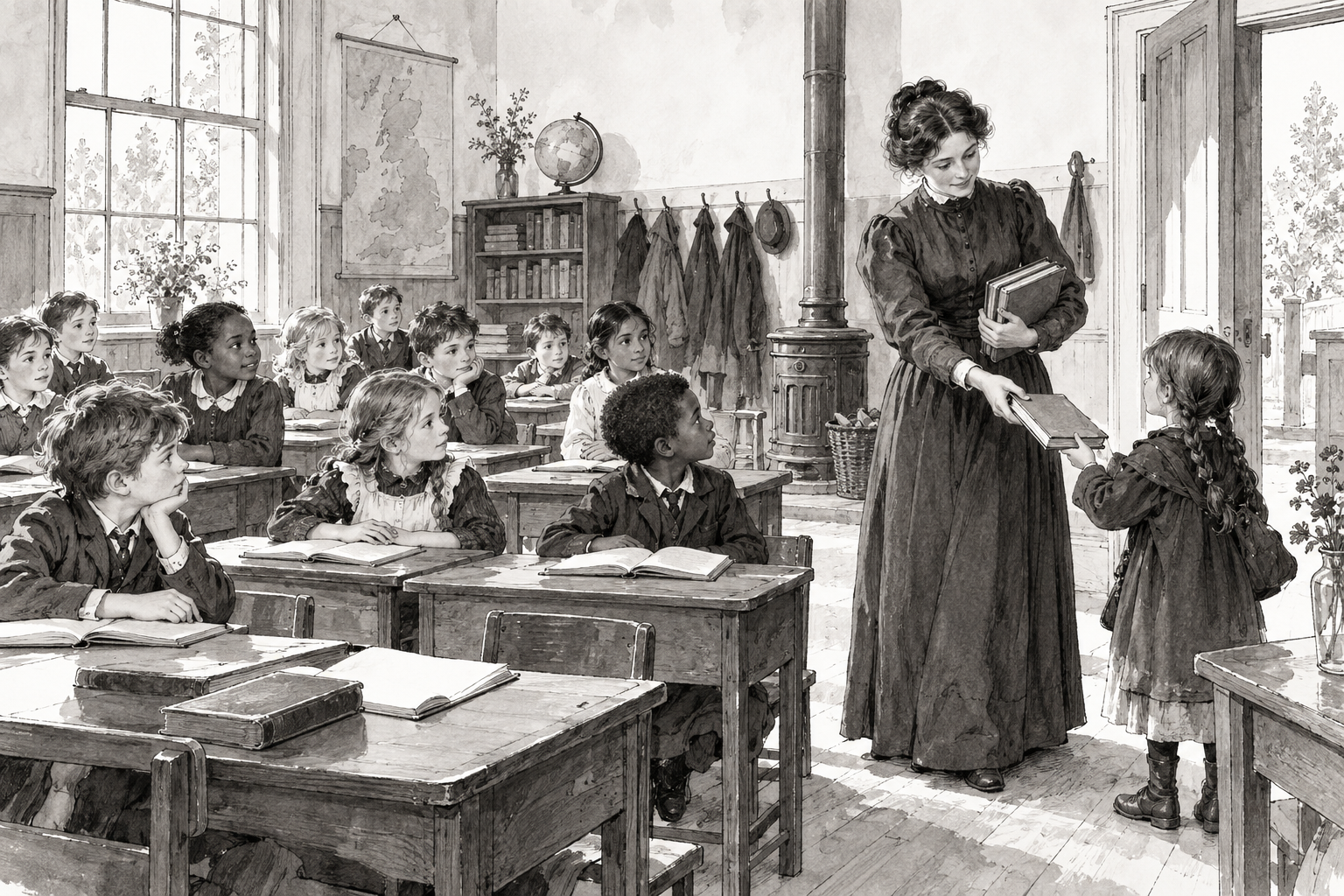
There is no single person who first deserved an education, and no single country that invented learning. Families, communities and religious institutions taught long before modern national school systems. This essay follows one narrower development: the expansion of publicly organised elementary schooling in England and Wales. That geographical limit matters. A national legislative story should not be mistaken for the history of human intelligence.
The Education Act of 1870 established a framework for elected school boards to supply elementary provision where existing schools were insufficient. It worked alongside voluntary schools rather than replacing them with one completely new system. The Act represented a major commitment to provision, but it did not immediately make all elementary education both free and compulsory. Those changes came through later legislation. [1]
Parliament's historical chronology identifies the 1880 Act with compulsory attendance for children aged five to ten. Removing school fees was a separate step from requiring attendance. Keeping these stages separate prevents a familiar mistake: treating the announcement of an institution as the immediate fulfilment of its promise. A place to learn, an obligation to attend and the removal of fees answer different obstacles. [2]
Even these distinctions leave practical questions. A child may have a legal place while lacking adequate food, suitable clothing or time free from other responsibilities. A family may value learning and still depend on the child's contribution at home. We should be careful about interpreting absence as indifference before examining what attendance costs. The classroom begins outside its own door, in the arrangements that make reaching it possible.
There is also a difference between being educated and being prepared to remain in an assigned position. Instruction can give someone the tools to question the world, or train them to accept a narrow place within it. These purposes can coexist within the same lesson. Teaching a child to read opens possibilities that no curriculum can entirely control, even when obedience is among the institution's intended outcomes.
This is why the word deserving makes me uneasy. It invites us to rank children before they have had the opportunity to show what interests them. The quiet pupil, the late developer and the child whose abilities do not resemble an examiner's preferred answers may all disappear behind a confident judgement about potential. Education should help us discover capacities that earlier circumstances have concealed.
My own reflection is that access should include permission to be more than immediately useful. A person need not justify reading a poem by promising that it will raise their earnings. Practical skills matter enormously, but a restricted diet of usefulness can become another way of distributing intellectual freedom unequally. Some people are encouraged to explore; others are asked to prove in advance that exploration will pay.
The history of schooling is therefore not completed by counting seats. We should also ask what pupils are allowed to encounter, which questions they may pursue and whether they can continue when learning takes an unexpected direction. An open classroom door matters most when it opens onto more than one acceptable future. The child arriving with a book should not already have been assigned the ending.